Back to Meetings
[Asia-Pacific Ocean Week] From Sites to Seascapes: Strengthening Cooperation for Marine and Coastal Conservation
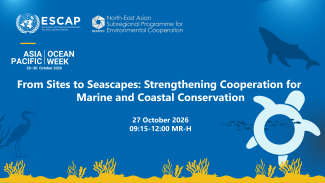
Achieving Target 3 of the Kunming-Montreal Global Biodiversity Framework depends not only on expanding protected and conserved areas, but also on ensuring that they are effectively managed, well connected and integrated into wider landscapes and seascapes. For marine and coastal ecosystems, this means looking beyond individual designations and considering how sites contribute to ecological connectivity across a broader seascape.
The Yellow Sea provides a practical context for this discussion. Its interconnected tidal flats and coastal wetlands across China, the Democratic People’s Republic of Korea and the Republic of Korea support globally significant biodiversity and critical habitats along the East Asian-Australasian Flyway. Recent World Heritage developments across the Yellow Sea have increased recognition of the Yellow Sea’s shared conservation value. The Busan Statement on Cooperation for the Conservation of the Tidal Flats and Coastal Wetlands of the Yellow Sea has also identified common areas of interest, including technical exchange, monitoring, research and capacity-building. Together, these developments provide a timely basis for discussing how this momentum could support more focused and practical cooperation.
Building on these developments and earlier Yellow Sea discussions, including at the 2025 Our Ocean Conference, the session will provide a space for governments, site managers and regional partners to exchange experiences, clarify practical needs and consider how existing initiatives and mechanisms could support practical cooperation. It may also provide useful input to future coordination following the Busan Statement and help connect subregional experience to broader ocean action in the lead-up to the 2028 United Nations Ocean Conference.
• Mr. Shombi Sharp, Deputy Executive Secretary for Partnership and Coordination, Office of the Executive Secretary, ESCAP
• Ms. Soohyun Kim, Regional Director of the UNESCO Regional Office in Bangkok and Office for UN Coordination for Asia and the Pacific
The Session will present recent developments and practical experience from the Yellow Sea, moving from the broader regional context to World Heritage properties and individual conservation sites.
• Ms. Mi-Jin Lee, Research Associate, ESCAP ENEA / NEAMPAN
• Mr. John MacKinnon, UNESCO Expert
• Mr. Wu Qijiang, Director, Yancheng Wetland and Natural World Heritage Conservation and Management Center (recorded)
• Ms. Jinnie Choi, Secretary-General, World Heritage Promotion Team of Korean Tidal Flats
• Ms. Seon-mi Hwang, Team leader, Suncheon Bay Conservation Division, Suncheon Bay, Republic of Korea (recorded)
• Ms. Sheila Vergara, Project Manager–ASEAN ENMAPS, ASEAN Center for Biodiversity
The panel will consider how existing organizations, networks and stakeholders can complement one another in supporting practical cooperation. Panelists will be invited to make brief initial interventions of up to three minutes, followed by a moderated discussion.
• Moderator: Ms. Margarita Victoria Caballa, Marine and Coastal Ecosystems Lead, Secretariat of the Coordinating Body on the Seas of East Asia (COBSEA)
• Panelists:
o Ms. Helena Sterwe, Head of UN Resident Coordinator’s Office in the Democratic People’s Republic of Korea
o Ms. Yoon Kyung Lee, Deputy Chief Executive, East Asian-Australasian Flyway Partnership (EAAFP)
o Mr. Alexander Semenov, Director, Aniva Marine Station. Russian Federation
o Ms. Seongbo Kim, Network Officer, Ramsar Regional Center-East Asia (RRC-EA)
o Mr. Linlin Zhao, Associate Researcher, First Institute of Oceanography, Ministry of Natural Resources, China
• Mr. Riccardo Mesiano, Officer-in-Charge, ESCAP ENEA / NEAMPAN